By Flint Arthur
Could you lose your job to a robot in the next decade? There appears to be a race underway between robotics firms who believe they have a potentially viable, labor-disrupting product. It’s being described as a “moonshot.” In the first seven months of 2025 alone (a figure likely eclipsed by the time you read this; and certainly different in a thousand days), more than $6 billion has been invested into robotics startups,¹ with projections rising to $38 billion by 2035.² This is still only a fraction of overall spending on AI research, Large Language Models (LLMs), and the massive data centers required to train them. Nvidia, whose GPUs dominate AI compute, recently became the world’s first $5 trillion company. By 2026, AI operations may consume 90 TWh of electricity, equivalent to the entire country of Finland, or the combined usage of New York City and Washington, DC.³
Robotics firms are moving aggressively. They are forgoing patent law protections⁴ in favor of secrecy and speed in pursuit of first-mover advantage. They intend to sell mass-produced units through “Robots-as-a-Service” (RaaS) models,⁵ retaining ownership and control while renting out labor capacity. RaaS is rental access to labor capacity without ownership. Publicly, this is framed as a race between national productive capacities—primarily the United States and China.⁶ In reality, it is a class struggle over who will own the robotic means of production, and what the post-automation economy will look like in terms of taxation, redistribution, and social welfare. If unopposed, we will experience a concentration of capital and the creation of a permanent technofeudal class structure.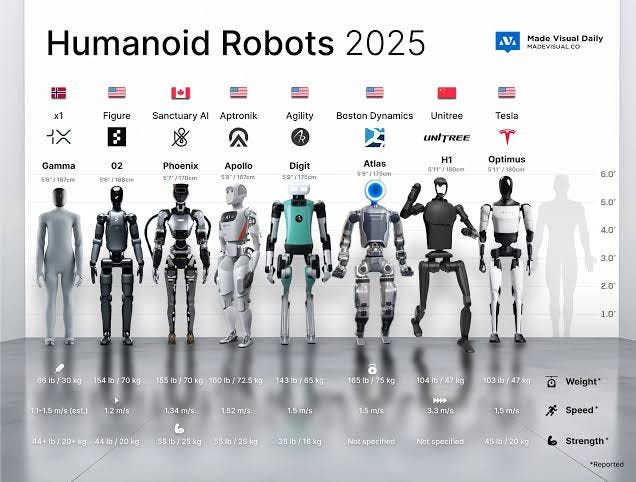
The Class of 2025: A snapshot of the rapid proliferation of humanoid robotics hardware. While public attention focuses on LLMs, physical autonomy is being solved in parallel by competitors in the US, Europe, and China.
Some argue⁷ that we're witnessing an end to capitalism as we know it, and its evolution into the next stage: technofeudalism and cloudist overlords. Neoliberalism and the 2008 Financial Crisis paved the way for it. The technocapitalist class is characterized by its control over technology-based companies, its ability to commodify data and intellectual property, and its influence on economic and social structures through digital means. They accumulate capital through technological innovation and digital services, often benefiting from the commodification of user behavior and information. Instead of owning factories (capitalism), they own the very platforms and algorithms that mediate labor and life itself (technofeudalism).
This labor disruption isn't mere speculation, it's the operating assumption of global economic elites. In 2016, World Economic Forum (WEF) founder Klaus Schwab presented research by Oxford economists Carl Benedikt Frey and Michael Osborne to corporate and political leaders, stating: “47% of total employment in the US is at risk, perhaps over the next decade or two, characterized by a much broader scope of job destruction at a much faster pace than labour market shifts experienced in previous industrial revolutions.”⁸ When the founder of the WEF, the organization that convenes the world's most powerful CEOs and heads of state, frames automation this way, it reveals the lens through which policy is being shaped. The plan of the technocapitalist class seems to be to first leverage AI agent cognitive job replacement⁹ through Software as a Service (SaaS), and then humanoid robot mass physical job replacement ahead of the demographic trend of retirement.¹⁰ They want the labor market disruption before the Boomer/older Gen X cohort retirement starts pounding social security and retirement portfolios. If they delay, the younger Gen X, Millennials and Gen Z will be in a position to push up wages. “Birth rates are falling below replacement levels in many regions of the world... the working-age population falls at the same time as the percentage of dependent elders increases… the general trend is that an ageing world is destined to grow more slowly unless the technology revolution triggers major growth in productivity.”⁸
For the dramatic “job destruction”, the pain is the point. If they roll out agentic AI software and the humanoid robots is too slow, the smaller working class is in a better bargaining position to demand higher wages, social spending paid for by taxing the wealthy or outright seizures of capital to pay for senior care. China, meanwhile, must also aggressively pursue robotization as a national strategic imperative¹¹ because of its own greying population¹² and its hostility to both immigration and offshoring Chinese productive firms abroad.
By hollowing out the “middle class” cognitive jobs (i.e. IT, software developers, business, finance, management, HR, teacher, nurse, therapist, engineering, pilots, police) now and rushing humanoid robotics as soon as possible, this technocapitalist class can force the crisis towards a Universal Basic Income (UBI) program that allows the concentrations of capital to remain. The U.S. does not have a UBI, Alaska’s dividends paid to residents from oil production is probably the closest thing, but unsurprisingly Elon Musk is one supporter.¹³ Musk “predicts” that as AI and robotics become more capable, they will eliminate the need for most human labor.
The reason we are not seeing a lot of talk in the public sphere about what is obviously coming, is that the elites want to change the facts on the ground materially in just a few years, rather than allow more time for a broader discussion that could result in a more fair and just social policy to emerge.¹⁴ The U.S. population is fighting over healthcare subsidies for the Affordable Care Act and funding food stamps, when we should be discussing the socialization of AI and robot firms.
Without the democratization and socialization of the means of automation, people will be left at the mercy of one of two grim alternatives: the whims of elite wealth (technofeudalism), or the political gambits of an increasingly authoritarian state; both armed with surveillance technologies beyond any Orwellian nightmare, drone warfare, and ethically unshackled counter-insurgency AIs ready to be deployed against any social movement that threatens the newly minted technofeudalism.
The goal of socialization is not the command-and-control of a central bureaucracy, but the creation of a Social Economy: a decentralized system where the essential infrastructure of robotic production is collectively managed for the common good, while smaller producers and localized markets retain autonomy for as long as people find them relevant.
Will we witness a viable labor disrupting product within a decade? What if firms were to offer the humanoid robot for trial to warehouses like Amazon and stores like Walmart at a rental of $14 per hour?¹⁵ This RaaS model, offering labor at $14 per hour (potentially $5-$7 per hour when scaled), turns the human worker from an employee into an immediately uncompetitive liability for the operating business. Think this is all far in the future? Then you should check out the Figure 03 product demo.¹⁶
The Torment Nexus has already been built, it turns out it was just late stage capitalism.
References
- Szkutak, R. (2025, September 12). We are entering a golden age of robotics startups — and not just because of AI. TechCrunch.
- Goldman Sachs. (2024, February 27). The global market for humanoid robots could reach $38 billion by 2035.
- Ramachandran, K., & Austin, J. (2024, November 19). Data center sustainability. Deloitte.
- PatentVest. (2025, May). Humanoid Robots: The Disconnect Between IP Strength And VC Funding Of US And European Humanoid Robot Startups.
- Park, J. (2025, September 16). Figure AI Raises $1 Billion to Build Humanoid Robots at Record $39 Billion Valuation. CTOL Digital Solutions.
- Nishimura, K. (2025, October 10). China, the United States, and the AI Race. Council on Foreign Relations.
- Varoufakis, Y. (2025, February 13). The next stage of capitalism | Yanis Varoufakis on technofeudalism and the fall of democracy | IAI. YouTube.
- Schwab, K. (2016). The Fourth Industrial Revolution. World Economic Forum.
- Tyson, L. D., & Zysman, J. (2022, May 01). Automation, AI & Work. Daedalus 2022.
- Sheets, N. (2024, April 15). An Aging Global Workforce Threatens Growth. AI Could Help. Barrons.
- DBS Bank. (2025, March 21). Robotics Sector.
- Zhu, Y., & Zhang, Q. (2025). Population Aging, Artificial Intelligence (AI), and Labor Quality: Evidence from Manufacturing Enterprises in China. Journal of Business and Economic Research (JBER), 1(5).
- Elon Musk on why the world needs a universal basic income. (n.d.). World Government Summit.
- Hiebert, K. V. (2025, August 12). The Robot Revolution Will Trigger New Fault Lines for Democracies. Centre for International Governance Innovation.
- Dr Pero Micic on X. (2025, August 31). X.
- Figure. (2025, October 9). Introducing Figure 03. YouTube.
About the Author The author’s first computer was a Commodore 64 equipped with a 300-baud modem, which he used to access the local university’s VAX/VMS cluster to compile Fortran 77 and COBOL programs. He has worked professionally in information technology since 1997 and, against all odds, remains employed. This article may or may not have been written with the assistance of several large language models—but how would you know? Going forward, he will miss the em dash in human-written text almost as much as he had to untrain himself from hitting the space bar twice after every period.
Comments